How to Identify Your Light Bulb Base
Step 1 · Make sure your bulb fits
Look at the connector, not the bulb’s overall shape. Does it have spiral screw threads, straight pins, wire loops, or posts that turn to lock?
With the light off and the bulb cool, compare the old bulb’s base and printed code with the examples below. Measure the screw diameter or the distance between pin centers when needed. Illustrations are recognition cues, not actual size.
Match the exact base and the fixture’s voltage and rating. Similar-looking bases are not necessarily interchangeable; do not force a bulb into a socket.
Edison screw bases
Choose this family for spiral metal threads. “E” means Edison screw; the number gives the approximate base diameter in millimeters. E12 is small (candelabra), E17 is intermediate, and E26 is the standard medium size in many US homes.
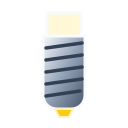
Small candelabra screw base (E12)
About 12 mm wide. A narrow screw base common in chandeliers and decorative lights.
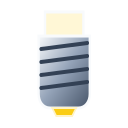
Intermediate screw base (E17)
About 17 mm wide. Between a small E12 and standard E26; found in some appliances and ceiling fans.

Medium screw base (E26)
About 26 mm wide. The medium screw base in most US household lamps and fixtures.
Pin bases
“G” / “GU” are pin-base naming families, but the physical connection varies by base type. GU5.3 has straight pins; GU10 and GU24 twist to lock. G9 has wire loops. Match the appearance first, then confirm the exact code.
 Straight bi-pin
Two thin, straight pins that slide into matching holes.

Tiny straight pins (G4)
Two slender straight pins, 4 mm apart, often on a small capsule bulb.
Spotlight straight pins (GU5.3)
Two straight pins, 5.3 mm apart, often on an MR16 spotlight. No twist-lock ends.
MR16 describes a bulb shape, not a base. Check whether its connector is GU5.3 straight-pin or GU10 twist-lock, and match the specified voltage.
 Loop-pin
Two small wire loops instead of straight pins.
Small wire loops (G9)
Two loop-shaped contacts, 9 mm apart, usually on a compact capsule bulb.
 Twist-lock
Two posts with wider ends that insert and turn to lock.
Short twist-lock base (GU10)
Two stubby posts, 10 mm apart, with widened ends. Insert and turn to lock; common on spotlights.

Two-pin twist-lock base (GU24)
Two posts, 24 mm apart, with widened ends. Insert and turn to lock; wider spacing than GU10.
 Tube-style pins
Pins on the ends of a long tube, often seated and rotated in the fixture.

Narrow-spaced tube pins (G5)
Two pins, 5 mm apart, at each end of many T5 tubes. Match the tube length and fixture requirements too.
Wide-spaced tube pins (G13)
Two pins, 13 mm apart, at each end of many T8 and T12 tubes. Match the tube length and fixture requirements too.
Tube length and electrical compatibility matter too. For an LED replacement, follow the product and fixture instructions for ballast compatibility and wiring. A matching G5 or G13 base alone is not enough.
Still not sure?
These are common residential examples, not every base. Other connectors include bayonet, single-pin, and multi-pin styles. Check the old bulb’s marking and fixture label before choosing a replacement.
The finder keeps your selected base. If your capsule or tube shape is not pictured in its next step, choose “I’m not sure” and continue with shape not confirmed.
Need a closer comparison? See E26 vs E12 base sizes or compare common bulb shapes.